


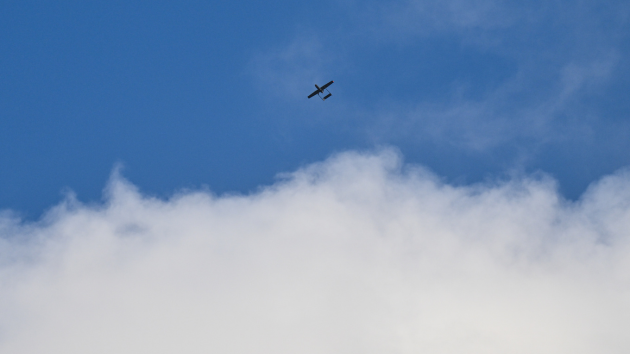
(LONDON) -- On NATO's southeastern flank, one ally is reporting an increasing rate of Russian drone violations and related air policing missions, as Moscow expands its long-range strike campaign against targets all across Ukraine.
Romania, a nation of some 19 million people, shares around 400 miles of border with Ukraine. To its east, Romania abuts the Black Sea, the Danube River and -- beyond that -- Ukraine, putting that part of the country in particular on the front lines of Russia's war against its neighbor and Moscow's wider showdown with the NATO alliance.
The contact zone there spans the Danube, the river's width of around 1,640 feet -- less than three football fields -- separating Romania and its NATO defenses from the Ukrainian river ports that have for years been a focus of Russia's long-range drone and missile bombardments.
Data provided to ABC News by Romania's Defense Ministry shows that the rate of Russian attacks on Ukrainian targets close to the NATO frontier is increasing, resulting in more regular scrambling of NATO fighters for defensive missions, more violations of NATO airspace by Russian drones and the discovery of more munition fragments on allied territory.
In all four categories, 2026 is set to be a record-breaking year, according to Bucharest's tallies.
As of April 28, since the start of 2026, Romania recorded seven airspace violations by Russian drones, the discovery of munition fragments 11 times and the scrambling of "Air Policing" missions 18 times, a Defense Ministry spokesperson told ABC News. Those incidents were the result of the 25 Russian attacks on Ukrainian areas close to Romania's border.
Within the first four months of this year, the figures are already approaching the record annual highs set across 2025, during which Romania reported nine airspace violations, the discovery of fragments 16 times, 21 air policing missions and 28 attacks on Ukrainian targets close to Romania.
In total since Russia launched its invasion, Romania has recorded 25 airspace violations, the discovery of fragments 47 times, 53 air policing scrambles and 91 attacks on Ukrainian targets close to the shared border, the Defense Ministry's data showed.
Thus far, then, the first third of 2026 alone accounts for around 28% of all airspace violations since 2022, 23% of incidents of fragment discovery, nearly 34% of all air policing missions and 27% of attacks close to Romania's border.
Constantin Spinu, a former Romanian Defense Ministry official who left his role in 2025, told ABC News that Bucharest always expected Russia to expand attacks along the country's shared border with Ukraine, particularly after the breakdown in 2023 of the Black Sea Grain Initiative -- negotiated between Russia and Ukraine in 2022 -- which had sought to ensure the safe flow of grain exports from southern Ukrainian and Russian ports.
"We were very much aware that this would happen," Spinu said. "It was not possible back then to foresee the amplitude of the attacks."
The first Russian drone was discovered on Romanian territory in the fall of 2023, according to officials in Bucharest, though that craft was not equipped with explosives. "We realized again that it was a matter of when, not a matter of if, drones equipped with explosives would hit Romanian soil," Spinu said.
The Defense Ministry's data, Spinu said, showed a "clear" and "growing tempo" of Russian attacks on Ukrainian targets along the Romanian border.
'Emphasis on restraint'
Romania has yet to shoot down any Russian drones or other munitions in its airspace, though national law does allow forces to engage drones in Romanian airspace during peacetime if lives or property are at risk.
There is no suggestion that Russian drones have been aimed at targets in Romania, Spinu said. "All the situations were consequences of their attacks on Ukrainian targets," he said. "I don't see this changing in the future."
Last week, British fighter jets were scrambled to track multiple drones attacking targets in Ukraine close to the Romanian border.
Initial reports suggested that the British aircraft intercepted the craft while they were in Ukrainian airspace, though the U.K. and Romanian defense ministries later clarified that the allied pilots tracked, but did not fire upon, the drones.
Romanian authorities said that around 200 people were evacuated during the incursion, which saw one drone land in the southeastern border city of Galati. Romanian President Nicusor Dan said it was "the first incident where Romanian property has actually been damaged, a threshold we take very seriously."
Following that incursion, Russia's ambassador in Bucharest -- Vladimir Lipayev -- told the state-run Tass news agency that the incident was a "provocation" by Kyiv.
Romania's Foreign Ministry summoned Lipayev to protest the violation. The ambassador, though, told Tass after the meeting, "Due to the lack of any objective evidence of the drone's national identification, the protest was rejected as far-fetched and groundless."
The incident again raised questions as to whether NATO forces should intercept Russian munitions close to allied borders while they are still in Ukrainian airspace.
Ionela Ciolan, a research officer at the Wilfried Martens Centre for European Studies think tank in Brussels, told ABC News that Romania's political leadership has shown "a consistent emphasis on restraint" regarding wayward Russian drones.
"Those in power in Bucharest are careful to avoid any actions that could be interpreted as direct participation in the conflict," Ciolan said. Questions as to a more assertive NATO posture "remain largely absent from the domestic agenda," she added.
Oana Popescu-Zamfir, the director of the GlobalFocus Center think tank in Bucharest, told ABC News that the government in Bucharest is broadly "downplaying these incidents and avoids commenting too much about them."
"The general perception that still the war is something that -- though it's on our border -- is still kind of distant," Popescu-Zamfir said. The official understanding appears to be that the violations are "not a direct act of hostility from Russia," she added.
That stance could be partly down to domestic political considerations, Ciolan said. "Romanian society has become increasingly polarized," Ciolan said. Recent data suggests that only about 55% of Romanians primarily blame the Kremlin for the war, while approximately 14% attribute responsibility to Ukraine and others point to the U.S. or the European Union," she said.
Russia launched its full-scale invasion of Ukraine in February 2022, with the declared intention of toppling Ukrainian President Volodymyr Zelenskyy's government in Kyiv.
The "special military operation," as the Kremlin described the invasion, followed eight years of fighting in eastern Ukraine, sparked by Russia's annexation of Crimea and fomentation of separatist rebellion in the eastern Donbas region.
The cost of action
The first instance of NATO nations downing drones came last year, when Polish and Dutch fighters destroyed three Russian drones over Poland. At least 19 drones penetrated Polish airspace in that instance, according to Warsaw.
After that incident, NATO Secretary-General Mark Rutte said Moscow was engaging in "reckless behavior" and said the incursion was not "not an isolated incident."
"Allies are resolved to defend every inch of allied territory," Rutte added. "We will closely monitor the situation along our eastern flank, our air defenses continually at the ready."
Russian officials have broadly denied any responsibility for munition incursions into neighboring nations, while also accusing NATO states of allowing Ukraine to use their airspace for routing drone attacks into Russia -- an allegation allied leaders have denied.
As incursions mount, politicians in NATO member states are facing more public pressure to take action. But a more assertive response could carry political, military and economic risks, the analysts who spoke to ABC News said.
"It is extremely costly to shoot down drones that may only cost a few thousand euros with missiles that can cost hundreds of thousands, or even millions, of euros," Ciolan said. Engaging incurring Russian drones could also hand Moscow useful military intelligence on NATO capabilities.
Romania and other NATO allies are rushing to adopt versions of cheaper counter-drone munitions showcased by Ukraine. In January, for example, Romanian military chief Gen. Gheorghita Vlad said Bucharest planned to acquire the U.S.-made MEROPS interceptor drone.
The costs of intercepting could also balloon if targets are engaged over populated areas, with drones, defensive munitions and falling debris all posing risks to people and property on the ground.
"It doesn't make sense from an economical point of view, but also from a public safety point of view," Spinu said.
Popescu-Zamfir said that while Romania has "made progress" on the issue, the country largely lacks the political will and means to engage.
"We now have a clear legal framework that actually allows us to directly engage the drones," she said, "and it also allows the pilots, in cases where we use fighter jets, to make that decision."
"But we don't actually have the equipment," Popescu-Zamfir added. "We have started positioning more radars and sensors around the Danube Delta, but we're nowhere near where we should be."
Romania, along with its NATO allies, faces a difficult and ever-evolving threat, Spinu said.
"You cannot install defensive equipment that would cover the whole border of Romania with Ukraine," he explained. "That's not militarily or economically possible. And no country in the world would be able to do that."
"It's a matter of risk calculation," Spinu said, suggesting that the defense of populated areas and critical infrastructure must take precedent over sparsely-populated border regions in which Russian drones have largely fallen.
"I don't think anyone has the perfect solution," Spinu added. "Not even the most developed armed forces in NATO."
Copyright © 2026, ABC Audio. All rights reserved.