


(NEW YORK) -- Millions in the Northeast are bracing for a powerful nor'easter set to bring pounding rain and strong winds to the region through the weekend.
The nor'easter could also cause power outages and could spark flight disruptions along the Northeast coast.
Here's the latest forecast:
Waves:
The storm is bringing massive waves for days, which will cause significant beach erosion.
Waves up to 19 feet have been recorded already along North Carolina's Outer Banks.
Waves up to 12 feet are possible from the Outer Banks to the New Jersey shore through Saturday, and along the New England coast through Sunday.
Coastal flood alerts are in effect from the Outer Banks to Maine, as some areas will see flood inundation up to 3 feet above normal levels.
Winds:
Strong winds are also a major threat as the nor'easter moves north.
The Jersey Shore, Rhode Island and Massachusetts coasts are under a high wind warning from Friday night to Sunday, with dangerous gusts up to 60 mph possible.
The Jersey Shore is under a high wind warning from Friday night to Sunday, with dangerous gusts up to 60 mph possible.
New York City could see wind gusts of 40-to-50 mph Friday night through Sunday.
Rain:
The rain will move in Saturday morning, falling from New Jersey to Massachusetts throughout the day.
The storm will reach peak strength on Saturday and then weaken slightly on Sunday as it stalls over New Jersey.
On Sunday, the rain will become more scattered, but still much of the day will be wet from Washington, D.C., to Maine.
The nor'easter will weaken on Monday as it slowly moves into New England, and then will die out on Tuesday.
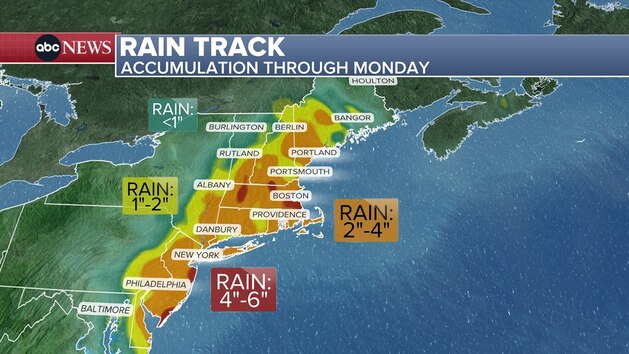
The storm could bring 4-to-6 inches of rain to Boston, Rhode Island, coastal New Jersey and Long Island, New York, with a widespread 2-to-4 inches of rain from Delaware to Maine.
Isolated flash flooding is possible, but because this rain is falling over multiple days, widespread and significant flash flooding is unlikely.
Nor'easters get their name because winds over the coastal area are typically from the northeast. These storms may occur at any time of year but are most frequent and most violent between September and April.
Nor'easters nearly always bring precipitation in the form of heavy rain or snow, as well as gale-force winds, rough seas, and coastal flooding.
Copyright © 2026, ABC Audio. All rights reserved.